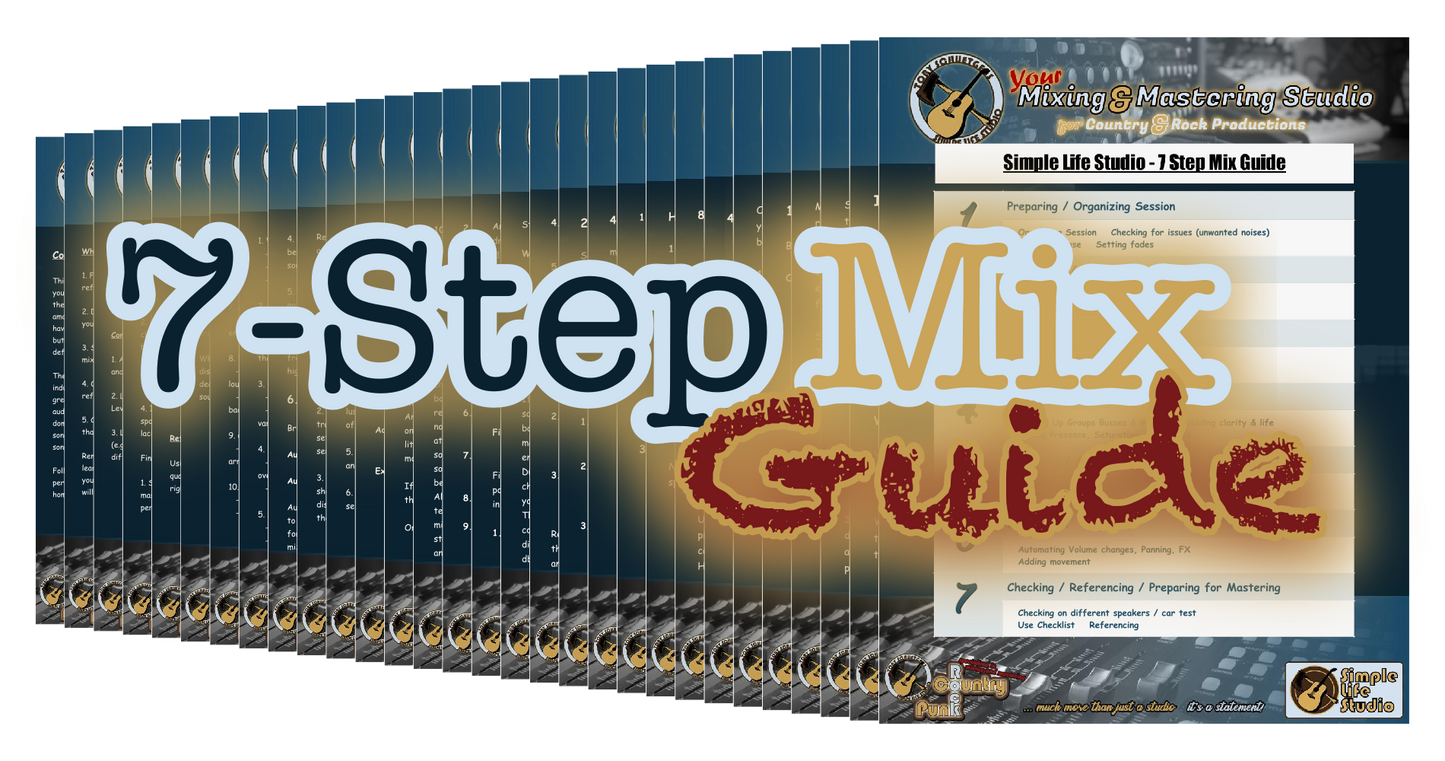
The Simple Life Studio 7-Step Mix Guide breaks down the mixing workflow into a practical, 7-stage system focused on emotional impact, creative flow, and efficiency rather than rigid rules or numbers.
Step 1: Mix Prep & Set-Up (Session Organization)
Arrange, label, and color-code tracks; build reusable templates.
Clean up artifacts (clicks/pops), align phase (especially drums), and apply smooth fades.
Group tracks into sub-busses and route them logically.
Step 2: Static Mix (Volume & Panning Only)
Set levels and stereo placement using faders and pre-gain only (no plugins yet).
Keep channel faders near 0 dB (unity) for precise control.
Aim for -15 dB average on the drum bus and leave at least 6 dB headroom on the mix bus.
Step 3: Fixing Problems (Corrective Processing)
High-pass/low-pass unwanted frequencies and fix frequency overlaps in mono.
Tame peak dynamics with compressors.
Rule: Don't actively hunt for non-existent issues (avoid extreme EQ sweeps); keep moving to preserve energy.
Step 4: Groups & Top-Down (Macro Processing)
Route sub-mixes into main busses (Drums, Vocals, Guitars, etc.) and out to the Mix Bus.
Start processing from the Mix Bus down (broad EQ/compression), then adjust group busses, and only zoom into single tracks when strictly necessary.
Step 5: Enhancing & FX (Depth & Space)
Add reverbs and delays via Send/Return busses (rather than inserts) for cohesion.
EQ your reverb returns (high/low pass) and use pre-delay to keep the dry signal clear.
Use saturation to add warmth, character, and excitement.
Step 6: Automation (Movement & Energy)
Automate volume rides for vocal consistency, dynamic section swells, and fills.
Automate panning, filter sweeps, and send levels to add motion and highlight transitions.